

You can be right about who will win an election and still pay too much to bet on it. On prediction markets, the price available when you open the app may be gone by the time you try to buy, especially when news sends other traders rushing toward the same outcome.
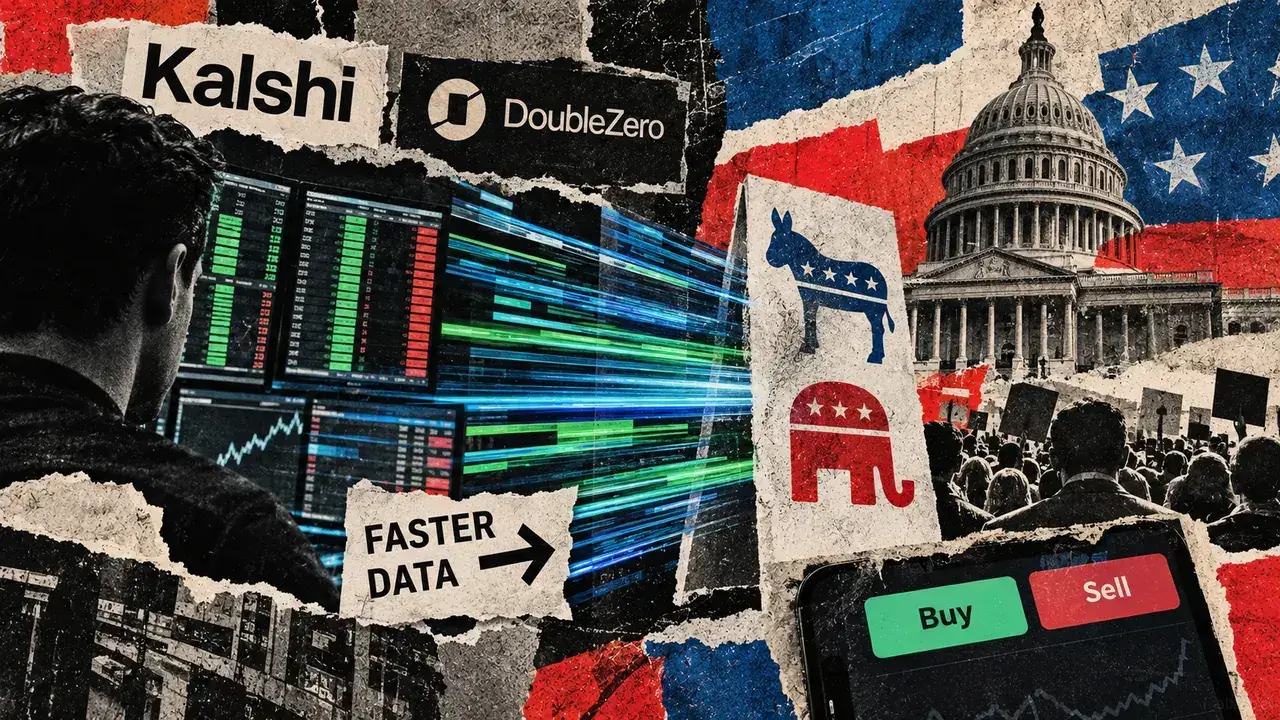
It took very little time for the market to see a business opportunity in this. On Sept. 9, DoubleZero announced that it had added Kalshi’s election and politics markets to Edge, a service designed to deliver trading data over a dedicated network. It carries the exchange’s order book, showing the prices and quantities people are willing to buy and sell.
DoubleZero told CryptoSlate that faster, more dependable information can help professional trading companies offer better prices. If competition passes those savings to customers, ordinary bettors could benefit. But using the feed effectively requires software and money, giving well-equipped companies another way to compete with people placing bets on their phones.
Election betting seems to be the great equalizer for both professional trading companies and retail users. Some participants want to back a political judgment for months; others want to profit from the next movement in price. Faster data serves that second business particularly well.

What happens between the prediction and the payout
On Kalshi, a standard yes-or-no contract pays $1 if its outcome happens and nothing if it doesn’t. Buy a yes contract for 60 cents, and you’re risking 60 cents for a potential 40-cent profit before fees. The price is commonly interpreted as roughly a 60% probability, though costs and trading conditions can erode that number quite a bit.
You can also sell before the election. Suppose you buy 1,000 contracts at 60 cents and sell them at 65 cents. Provided both trades execute at those prices, you’ve earned $50 before fees, regardless of who eventually wins. Predicting the next buyer’s willingness to pay can therefore be profitable long before you know the actual outcome of the election.
That gives traders a reason to follow the order book. Its best bid is the highest price a buyer offers, and its best offer is the lowest price a seller accepts. The gap between them is the spread. The quantities available tell you how much can trade before buyers or sellers have to accept another price.
Imagine good news about a candidate prompts traders to buy. Someone receiving updates quickly can see the cheaper offers being taken and reassess what to pay. Someone looking at an older view might still see contracts that have already sold. Their purchase depends on what’s available when their order reaches the exchange.
Edge delivers information about that market activity. Its subscribers only get bids and trades, not insider information about elections. Kalshi already provides a streaming connection called a WebSocket, which sends updates to trading programs. Services such as Edge compete over how that data reaches the recipient.
But receiving it is only the first part of the process. Trading software then has to interpret the update and decide whether to trade, and orders still have to reach Kalshi. The exchange uses price-time priority, meaning that price and when an order entered the queue determine its place. A faster feed can help someone act sooner, but the subscription itself gives them no reserved position.
Who gets the better deal?
This is particularly well-suited for market makers, firms that continually offer to buy and sell so other people have someone to trade with. They try to earn enough from those prices to cover their losses and operating costs.
Suppose a market maker offers a contract at 60 cents, then news persuades buyers that it’s worth closer to 70 cents. They can take the old offer while the seller is still processing the information. Repeated losses of this kind can make companies charge wider spreads or offer fewer contracts, making trading more expensive for everyone else.
Faster information can help them update their quotes, including when other traders reprice related contracts. If several companies can manage that risk and compete for customers, they can offer narrower spreads. Someone making an occasional bet could then get a better deal without buying a faster connection themselves.
That’s the potential benefit in DoubleZero’s pitch, but it requires evidence from actual trades. Delivering data sooner and giving customers better prices are separate achievements. To make this a convincing comparison, we would need to examine the prices and quantities available during busy political events, when traders most need dependable information.
The company’s connection guide describes a paid feed and software that converts incoming data into messages an application can read. That lowers the work needed to connect, but subscribers still need a program that can make decisions and handle interruptions, along with funds to trade. Large companies can spread those costs across much more activity than an independent trader.
Access to the same subscription therefore leaves plenty of room for unequal capabilities. For someone holding a bet for months, a tiny delivery advantage with profits measured in fractions of a cent may be irrelevant. But for a company continually updating thousands of quotes, it can significantly affect the profitability of repeated trades.
The odds travel beyond prediction markets
DoubleZero brings crypto infrastructure into this business. Its network combines privately supplied fiber links and hardware, and its blockchain services include connections for Solana validators. Both validators and trading firms have reasons to pay for dependable communication.
Distributing election data gives political probabilities another route into financial decisions. Consider a hypothetical crypto investor who believes a particular congressional outcome would improve the prospects for legislation affecting the industry. Election odds could become one input when assessing crypto companies or a Bitcoin position, with software receiving updates automatically.
The investment judgment still involves several uncertain steps. Winning a chamber doesn’t guarantee legislation will pass, and passing legislation doesn’t determine an asset’s price. Other investors may already have accounted for the same news. Even an accurate political forecast can lead to a bad trade if the buyer pays too much.
CryptoSlate has examined the commercial value of prediction-market information, but a number doesn’t become more reliable just because it travels faster. Its value depends partly on the market behind it. A price that’s supported by only a few contracts says nothing about where a larger transaction could execute, and a sudden movement might reflect sellers withdrawing rather than new evidence about the election.
That also affects how the public reads the odds. When a probability appears in political coverage, the number can look more authoritative than it actually is. Knowing how much money is available at that price gives it context, although even a deep market represents only people that are willing and able to trade, with no way of telling whether they look anything like the actual electorate.
Confidential information creates a separate problem. In its Feb. 25 enforcement advisory, the CFTC described Kalshi disciplinary cases involving a candidate trading on his own candidacy and a YouTube editor trading contracts tied to unpublished videos. Those cases involved conduct and information advantages that went beyond the speed of a connection.
Platforms have to distinguish how someone learned something from how quickly their computer received it. Faster distribution can make public market data more accessible, while surveillance addresses prohibited conduct; neither job substitutes for the other.
For ordinary bettors, the benefit of this infrastructure will come through the prices they can actually get. Competition between professional trading companies could make entering and leaving a position cheaper, even as those companies gain capabilities most customers never use. Showing that benefit means measuring what happens to prices and available contracts when political news breaks, when a person opening the app finds out what their prediction will cost.