

When corporate leaders discuss climate strategy, the message that still dominates is that, despite competing priorities and external pressures, sustainability matters.
According to the 2026 State of Supply Chain Sustainability report from the MIT Sustainable Supply Chain Lab, which surveyed 1,810 supply chain professionals across 91 countries, 83 percent rate sustainability as important or very important to long-term business success, the highest level in the report’s seven-year history.
But commitment, the report reveals, is not the same as capacity. While 59 percent of respondents report becoming more committed to sustainability following recent U.S. policy shifts that deprioritize environmental concerns, the same organizations are being forced to compromise those commitments. Sixty-eight percent report that tariff uncertainty has compelled them to delay, scale back, or abandon sustainability strategies. Nearly one-third have seen tariff-related disruptions actually increase their operational emissions.
“Commitment is strong, measurement is expanding, and AI is accelerating,” says Sreedevi Rajagopalan, director of the MIT Sustainable Supply Chain Lab and lead author of the report. “What comes next is harder: converting commitment into accountability, operational integration into strategic decision-making, and incremental decarbonization into genuine transition.”

The result is a supply chain sustainability agenda stuck between conviction and constraint.
Beyond tariffs, more than eight in 10 respondents across North America, Europe, and Asia agree that ongoing geopolitical conflict is reducing the effectiveness of their organization’s climate action. Organizations built decarbonization plans on assumptions of stable trade and relative peace, yet neither assumption is holding.
The external disruption reveals an internal vulnerability. Among companies with publicly stated sustainability goals, only 51 percent have established a formal cross-functional sustainability team, which is the governance structure most strongly associated with embedding sustainability into daily decisions. In addition, only 33 percent place sustainability oversight at the board level. Public ambition, in other words, is vastly outrunning internal accountability infrastructure. Companies with formal cross-functional teams report sustainability is “frequently or always” built into decisions 57 percent of the time. Where responsibility sits in a single function, that drops to 13 percent — a 44-point gap illustrating the return on governance investment.
Sustainability is embedding most deeply where companies make daily operational choices: transportation and logistics (39 percent), procurement (35 percent), warehousing (34 percent), and product design (33 percent). However, it thins out dramatically in decisions that lock in long-term emissions: capital investment, network design, and supply chain risk planning. This reveals that companies are becoming better at operating more sustainably, but not at designing sustainable supply chains in the long term.
The artificial intelligence story compounds this tension. Seventy-eight percent of North American organizations report current use of AI in sustainability initiatives, and 87 percent of adopters report positive impact on sustainability goals. Eighty-six percent have reduced material waste, 81 percent have reduced energy use, and 63 percent use AI to estimate missing supplier emissions data. However, among mature agentic AI users, only 53 percent report a reduction in total greenhouse gas emissions. Twenty-nine percent report an increase, suggesting that operational efficiency does not automatically translate into lower net emissions.
This tension is particularly visible in warehousing. Among advanced and fully automated warehouses using AI, 78 percent report higher energy use since implementing AI, and 76 percent report higher waste, yet only 24 percent use AI-driven real-time monitoring to track environmental consequences. Many organizations may not realize their energy footprint is climbing until well after implementation.
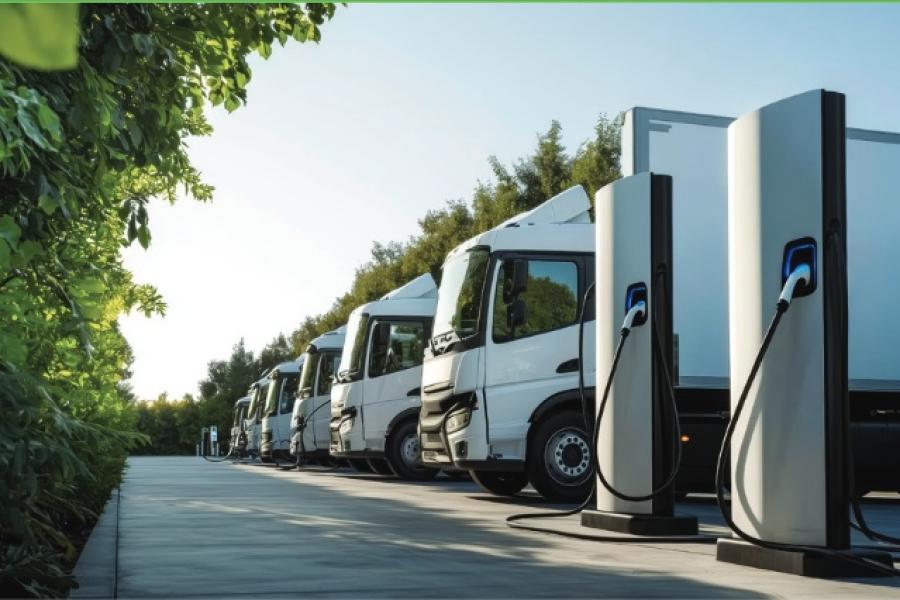
Another key area of the report is freight transportation. Nearly every freight company is reducing emissions through route optimization, load consolidation, and driver-behavior programs. However, 43 percent of fleets still operate mostly or entirely on conventional diesel and only 8 percent have completed a full transition to low-emission energy. The divergence between regions reveals why: In Europe, 84 percent of freight companies report that recent policy changes have positively affected decarbonization strategy. In North America, only 44 percent do. When policy signals are unclear, capital-intensive technology transitions stall. For example, battery-electric vehicles are at scale in 60 percent of European companies, but only 36 percent in North America.
The report reveals that one bright spot has emerged in Scope 3, or indirect, emissions collaboration. Participation in joint supplier engagement and decarbonization programs surged from 31 to 58 percent in a single year. In addition, partnerships to manage shared suppliers’ emissions more than doubled, from 23 to 55 percent. The share working entirely alone collapsed from 18 to 6 percent. The report, supported by the C.H. Robinson Foundation, Breakthrough, and CO2 AI and Dassault Systèmes, reveals that companies are recognizing that Scope 3 cannot be solved in isolation.
Across all these areas, the consistent pattern the report reveals is that corporate commitment is not the prevailing constraint to ongoing sustainability efforts. Rather, governance, accountability structures, technology infrastructure, and measurement capabilities are the current obstacles. Organizations that close the external gap by building resilience against disruption and the internal gap by hard-wiring accountability into structure will be the ones whose commitments survive. Those that do not will find that ambition without accountability moves the needle very little.